

Gamers are diverse!
~ a brief history of gaming ~
Frequently misunderstood point; let's be clear
Did you know? Gamers come from all walks of life and cultural backgrounds! Although any gamer who has ever gamed is *a* gamer, we dedicated Gamers are a specific breed. We don't believe play and a good time ends because of a border, race or religion coming between us. Our gender? The answer is probably gamergendered, if you know what we mean. What matters is that you want to have a good time and respect everyone else's ability to do so. We can't force anyone to have one, but we welcome all to try! To know more, read on...
Before we can tell you about where we are today, we have to look back at our history! Let us begin with...
The Origins of Gaming
Since ancient times, humans—men—gamed!
Egypt and the game of Senet – One of the oldest known board games, it was played in Predynastic Egypt. It had religious significance, reflecting the journey to the afterlife. It was played as early as ~3100 BCE. Over 2,300 years before the founding of Rome!
China. The game of Go, played in 2500 BCE and possibly as early as 4000 BCE. Initially used for military strategy, it became a strategic board game symbolizing intellectual skill.
Royal Game of Ur (Mesopotamia, ~2600 BCE) – A racing game from ancient Mesopotamia. It was played with dice. It combined luck and strategy, influencing later board games.
Knucklebones (Ancient Greece/Rome, ~500 BCE) – A game similar to jacks, played with animal bones or carved stones, blending skill and chance.
Petteia (Greece, ~5th century BCE) – A Greek strategy board game, possibly a precursor to Roman Latrunculi, involving moving pieces to capture opponents.
Snakes and Ladders (precursor to Chutes and Ladders) is from ancient India, dating back to the 2nd century BCE in its oldest recorded origin. It was originally called Moksha Patam or Paramapada Sopanam. The game was used to teach moral lessons, symbolizing the journey of life: ladders represented virtues (e.g., generosity, faith), while snakes symbolized vices (e.g., greed, anger). It was associated with Hinduism, Jainism, and Buddhism, reflecting concepts of karma and moksha (liberation).The British later adapted it during the Victorian era, simplifying the moral themes, and it eventually became Snakes and Ladders, later evolving into Chutes and Ladders in the U.S.
Latrunculi (Rome, ~1st century BCE) – A Roman military strategy game, similar to chess or checkers, focusing on tactical captures.
Tabula (Rome, ~1st century CE) – A Roman precursor to backgammon, involving dice and movement around a board to bear off pieces.
Patolli (Aztec, ~200–900 CE) – A Mesoamerican gambling and race game using beans as dice, reflecting chance and strategy.
Chess (India, ~6th century CE) – Derived from Chaturanga, representing military units. It evolved through Persia (Shatranj) and spread to Europe, becoming modern chess.
Mancala (Africa, ~600–700 CE or earlier) – Possibly originating in East Africa, this "sowing" game involves moving stones between pits. Its variants spread across Africa, the Middle East, and Asia.
Many changes in the world happened over that span of time, and games changed, too! Sport evolved and was at times played alongside, before or after what evolved into traditional gaming, and far earlier than video games! In review...
The Classical Era
The Olympic Games
The Olympic Games began as an ancient Greek athletic-religious festival and evolved into a global modern sporting competition. The Olympics represent a shift from ritualistic contests to codified, international competition structured around performance, rules, and symbolic prestige.
Originating in Olympia, Greece, traditionally dated to 776 BCE. These ancient games were held in honor of Zeus and featured athletic contests like footraces, wrestling, and chariot racing. Participation was restricted to free Greek men, emphasizing physical excellence and civic pride. (Homer's Odyssey mentions several of these in its epic tale!)
After their decline in 393 CE under Roman Christian rule, the Olympic tradition was dormant until revived as the Modern Olympic Games on 04/06/1896 in Athens. Spearheaded by Pierre de Coubertin, this modern revival emphasized standardized sport, internationalism, and amateurism—values aligned with the late 19th-century ideal of structured competition. Over time, the Olympics expanded to include Winter Games (1924), female athletes, and professionalization. Framed through gaming, the Olympics can be seen as an institutionalized meta-game system: a fixed rule set applied periodically to determine national and individual supremacy in diverse disciplines, all within a highly ritualized global stage.
Medieval and Renaissance
Games of Sport, Chance, and Cunning
Games in the medieval and Renaissance eras reflected martial values, social hierarchies, and theological worldviews. Physical sports emphasized prowess and honor; games of chance reflected fate and divine will; strategic games modeled order, intellect, and power. These intermediate forms of live competitive challenge represented a proto-modern gamer culture whose influence is felt down to present in everything from Jai alai, Pickleball, MMA, to Laser Tag and Pokemon. Let's take a look...
Sport
Jousting
Mounted combat with lances, central to knightly tournaments; formalized in 13th century Europe.
Melee
Group combat sport, often chaotic; part of chivalric training and pageantry.
Archery
Both military training and competitive pastime, especially in England after the 13th century.
Mob football
Violent, unregulated village-wide ball games; precursors to modern football/soccer.
Pallone
Italian ball game played with inflated balls and gauntlets; Renaissance courts popularized variants.
Chance
Dice games
Widespread among all classes; six-sided dice were common; games included hazard, precursor to craps.
Teetotum / Dreidel
Dreidel is widely regarded by historians as a Jewish adaptation of the game of Teetotum, using a top of the same name–a popular European gambling tradition by the 18th century. The teetotum used letters indicating game actions—such as "Take All," "Half," "Nothing," and "Put"—while the dreidel replaced these with Hebrew letters (nun, gimel, hei, shin) that preserved the same mechanics while later acquiring Jewish religious symbolism associated with Hanukkah.¹
Cards
Introduced in Europe in the 14th century; tarot used both for gaming and divination.
Lotteries
Early public gambling, used in Renaissance Italy and later in Elizabethan England for civic funding.
Cunning
Chess
Spread from Islamic to European courts by the 11th century; symbolized war, hierarchy, and intellect.
Fox and Geese
Asymmetric strategy board game; common by the 15th century.
Morris games (e.g. Nine Men's Morris): Abstract alignment games requiring spatial foresight, played since antiquity.
Riddles and logic contests
Featured in courtly and academic settings; mental games tied to social prestige.
While games, public sport and spectacle thrived in Europe during this time, lesser-known in the present day are the many varieties of board, table and kinetic games that were widely enjoyed around the world:


Games Outside Europe in the Medieval and Renaissance Period (appx 500–1600 CE)
Middle East & Islamic World
-
Shatranj: Islamic variant of chess; popular across
Persia and the Abbasid Caliphate. Intellectual
and courtly pastime.
-
Backgammon (nard): Played since ancient Persia; strategic race game with dice, symbolizing chance and calculation.
-
Archery contests: Valued both militarily and spiritually in Islamic cultures. Often formalized with rules and ranks.
China
-
Go (Weiqi): Ancient strategy game emphasizing balance and territory; associated with scholarly and elite refinement.
-
Xiangqi (Chinese chess): Popular military-themed game; widespread by the Song Dynasty.
-
Cuju: Ball-kicking game resembling soccer; played in courts and military contexts.
-
Pitch-pot (touhu): Competitive throwing game with Confucian ritual associations.
Japan
-
Kemari: Aristocratic ball game played to maintain ball aloft, non-competitive but ritualized.
-
Go (adopted from China)
-
Shogi: Strategy game held in high regard by samurai and nobility.
-
Hanafuda: Playing card game oft featuring natural motifs, several play-styles available
India
-
Pachisi: Cross-shaped race game; origin of Ludo. Symbolic of fate and royal leisure.
-
Chaturanga: Precursor to chess; simulates fourfold division of ancient Indian armies.
-
Kalaripayattu: Martial art with performative and competitive elements, especially in southern India.
Mesoamerica
-
Ullamaliztli (Mesoamerican ballgame): Ritualized rubber-ball game played on formal courts; often associated with cosmology and human sacrifice.
-
Patolli: Gambling board game played with beans and dice-like elements; popular among Aztecs.
Africa
-
Mancala-type games (e.g., Oware, Bao): Stone-counting strategy games played across sub-Saharan Africa; cognitive and social function.
-
Wrestling and stick fighting: Competitive and ceremonial sports in West and East Africa; sometimes initiatory or dispute-resolving.
Globally, games in this era embodied distinct cultural values; cosmic order in Mesoamerica, moral discipline in Confucian East Asia, strategic depth in Islamic and Indian traditions. Games of skill, chance, and cunning were found worldwide, shaping and reflecting religious, social, and political systems across continents.
Enlightenment era to early modern day
The Enlightenment era was one of exploration, military conquest and vast civilizational reforms. During this period, the games of the court, the field, the lecture hall and the monastery courtyard were largely overshadowed by the events of the world around them. As technology and warfare hurtled humankind's means of everyday life, living, and leisure pastimes into new and changed forms, styles, and formats, games continued.
Underrated by present-day pop-culture and some contemporary historians, the parlor games of European coffee houses, Eastern tea houses and, monastic orders worldwide went on. As trade and travel brought games' influences farther and wider than ever before, appreciation of games that were traditionally more local and national in character reached every corner of the Earth!
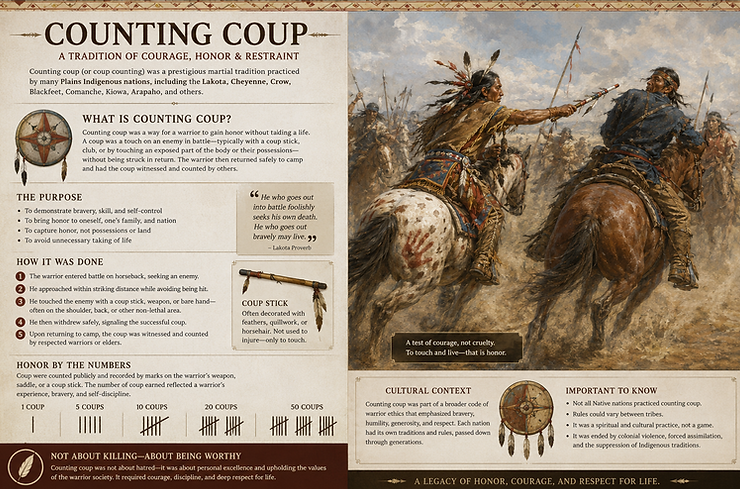
In the Americas, the warrior tradition of Counting Coup deserves an honorable mention. Even though it was not one universally shared by native tribes, and had religious and military significance over and above any notion of being a mere game, it has the markings of what many would recognize as being a 'war game' today!
By far, though, peace-time, and peaceful play has been the consistent thread throughout human gaming experience. With one outstanding, unique historical example.




The Christmas Armistice - The Night the War Stopped
One night in 1914 changed the face of warfare forever
By December 1914, World War I became something nobody expected. The fast-moving campaigns of the summer had ground to a halt, with both sides dug into muddy trenches stretching from the North Sea to Switzerland. Soldiers faced freezing temperatures, constant artillery fire, poor food, disease, and the daily possibility of death. Christmas was approaching, but few expected anything different from another miserable night at the front.
On Christmas Eve, something remarkable began to happen. In several sectors along the Western Front, German troops started decorating their trench lines with small Christmas trees lit by candles. Others began singing Christmas carols, including Stille Nacht ("Silent Night"). Across No Man's Land, British troops listened, recognized the melodies, and answered with carols of their own. Instead of rifle fire, the night air filled with the sound of song.
As dawn broke on Christmas Day, hesitant calls came from the trenches. Soldiers cautiously climbed out, some unarmed, meeting one another in the middle of the battlefield. What had been deadly ground only hours before became a place of conversation and curiosity. Men shook hands, exchanged cigarettes, chocolate, tobacco, canned food, buttons, badges, newspapers, and small souvenirs. Many used the opportunity to recover and bury fallen comrades who had been lying between the lines for weeks.
Language barriers did little to stop the encounters. Many Germans knew some English, while gestures, smiles, and shared experiences filled the gaps. The soldiers discovered that the men across the battlefield looked much like themselves: cold, exhausted, homesick, and hoping to survive.
In several locations, the informal truce expanded into games. The most famous story tells of impromptu football (soccer) matches played on the frozen ground. While details differ between eyewitness accounts, there is little doubt that soldiers kicked balls around, organized friendly matches, and briefly replaced combat with play.
The armistice was never universal. Fighting continued in many parts of the front, and some units never experienced any truce at all. Military leaders on both sides viewed the fraternization with alarm, fearing it weakened discipline and the willingness to fight. Orders soon arrived forbidding future contact with the enemy, and artillery fire gradually resumed. Within days, the war returned to its brutal routine.
The Christmas Armistice remains one of history's most powerful reminders that even in the middle of industrial warfare, ordinary people could still recognize one another's humanity. For a brief moment, shared songs, conversation, and games proved stronger than orders, politics, and the machinery of war. The conflict would continue for nearly four more years and claim millions of lives, but for one extraordinary Christmas, the battlefield became something almost unimaginable: a place of peace.
Statue in the United Kingdom commemorating the event
>
Sidequest: From the Olympics through present day—play as Alternative to Conflict
History is often remembered through its wars, but it is equally shaped by the moments when people chose competition over violence. The example of the Christmas Armistice, though historically unprecedented, is not the only such case. There are examples we can learn from where individuals and civilizations have opted for engagement, dialogue, sport, and playful competition. Games to enrich our lives, avoid breaches of the peace, and maintain harmony between nations, groups, and people. Games have repeatedly served as a means of channeling rivalry into structured, limited, or non-violent competition. They provide a common set of rules under which adversaries can test one another without resorting to bloodshed.
The ancient Olympic Games were among history's
earliest formal examples of this principle. During the
sacred Olympic Truce, Greek city-states suspended
hostilities to allow athletes and spectators to travel
safely to Olympia. Political rivalries remained, but
they were temporarily redirected into contests of
running, wrestling, chariot racing, and other athletic
events. Victory brought prestige not only to the
individual competitor but to their city-state,
demonstrating that honor and reputation could be
earned through excellence rather than conquest alone.
The modern era has repeatedly embraced this concept.
International sporting competitions—from the modern
Olympics to the FIFA World Cup—allow nations to pursue
prestige within carefully defined rules rather than on the
battlefield. Even at moments of intense geopolitical rivalry,
athletic competition has provided opportunities for
diplomacy, cultural exchange, and mutual respect.
The symbolism of competitors shaking hands after
a hard-fought contest has become one of the
defining rituals of international sport.
The underlying idea is far older. Throughout the ancient
Mediterranean and later among Celtic and Germanic
societies, the rite of battle by champion offered a means
of resolving or symbolizing wider conflicts through the
contest of a select few. From the mythical duels of
Menelaus and Paris in Greek tradition, to the combat
of the Horatii and Curiatii in Roman legend, to later
heroic duels celebrated in Germanic and Norse literature,
champions were understood to embody the honor and
fortunes of their peoples. While such encounters did not
always determine the outcome of wars, they reflected a
longstanding ideal: that the skill, courage, and resolve of individuals or small teams could stand in place of the devastation of armies.
That same principle eventually found peaceful expression in games of intellect as well as athletics. Chess has perhaps provided the clearest modern example of the "battle of champions." Throughout the twentieth century, world championship matches frequently carried political and ideological significance far beyond the sixty-four squares of the board.
The 1972 World Chess Championship between Bobby Fischer and Boris Spassky became an emblem of Cold War competition, with millions viewing the contest as a symbolic struggle between the United States and the Soviet Union. Decades later, hypothetical discussions of Fischer versus Garry Kasparov have captured the imagination of chess enthusiasts precisely because they represent a conflict that can exist entirely within the realm of ideas. Here, as in sport, individual champions stand in for nations, schools of thought, and generations of players, allowing rivalry to unfold through mastery rather than violence.
Games cannot solve every political dispute or prevent every war. They are not substitutes for diplomacy, justice, or negotiation. Yet history demonstrates that they provide something uniquely valuable: a framework in which rivals can compete fiercely while recognizing one another's legitimacy as participants rather than enemies. In doing so, games transform conflict into challenge, opponents into competitors, and victory into an achievement measured by skill instead of destruction. From Olympia to the modern era, play has repeatedly offered humanity one of its most enduring alternatives to violence.
As we see the history of gaming is often one of alternative to violence and conflict
These examples, taken from fact and fiction, showcase the human capacity for rules-based and honorable competition, limited in scope, or standing in place of violence. They illustrate a profound truth: once people begin interacting as players rather than enemies, they often discover shared humanity before shared differences.
"Gentlemen! You can't fight in here! This is the War Room!"
There are signs for a hopeful and better future for mankind where disputes in the modern world may be resolved this way, as well.
Who knows what the future holds ...?


The Computer Age
Early Computing - Charles Babbage
Then we got math machines. Introducing Charles Babbage.
He is widely credited as inventing the first computer. In the early
1800's, he began invention of what would one day evolve into
the modern computer with his design of the 'Difference Engine;'
basically, a large mechanical calculator.
Self-taught in higher forms of mathematics, he envisioned a labor-saving device that could spare people the necessity of long-hand calculations, especially in industrial applications. Although this machine was not recognizable as a computer to modern eyes, the Difference Engine was the first true computer before the age of electronics. It had basic mechanical memory to store figures and the ability to reliably return precision calculations.
The Difference Engine
He went on to design a more advanced version of this engine,
he called the Difference Engine No.2. It would fill an entire room
once completed. It was capable of far more advanced forms of
calculation. It used punch cards, paper tabs that contained cues
that could be read by machine, not entirely dissimilar from how
a Player Piano operates. This concept may be compared to the
modern MIDI-compatible machines which take stored musical
notation and interpret it, playing tunes on command in digital
systems like keyboards, synths, and of course, consoles and
conventional computers. Music is math, after all!
He was only able to complete a portion of the whole design
during his lifetime. It would be until 2002 that the entire machine
was constructed to completion. His original plans were used and
the built design matched his specifications. It included a separate printer – and they all worked!
So admired is his contribution to the foundations of modern computing, that a pair of Harvard alumni, Gary Kusin and James McCurry, in 1984 created a computer
software and accessories store named in his honor – Babbage's.
Alongside other staples of the early computer retail scene, such as Electronic Boutique, and bookstores with software sections, such as Waldenbooks and Borders, these outlets offered the general public some of their first opportunities to purchase off-the-shelf
computer games and software. As major retailers such
as Kmart, Sears, and later Walmart expanded into the
market, competition intensified, contributing to the
closure or consolidation of many smaller specialty
outlets.
Software pioneer, Ada Lovelace
Speaking of software, we now introduce the first computer programmer, a woman by the name of Augusta Ada Byron, better known as Ada Lovelace. A protégé and collaborator of Babbage's,
she was noted for her mathematical prowess and holistic approach
to the sciences. Unusually for a woman of her era, she explored a variety of scientific fields and corresponded with some of the most noted minds of the time, including no less than famous physicist Michael Faraday and the American author Charles Dickens. Strongly independent-spirited, her work anticipated many ideas that would later become central to modern software development.
Ada is widely regarded as the first computer programmer for her creation of the first published algorithm intended for execution by a machine: an adaptation of mathematical concepts into a machine-workable set of instructions for Babbage's proposed Analytical Engine. This code was designed to allow the Analytical Engine to calculate Bernoulli numbers. Though the Analytical Engine itself was never completed during her lifetime, Ada's algorithm was later confirmed to be mathematically sound and successfully executed through modern computer simulations of the proposed machine.
Note G — the first published computer program
Though Ada Lovelace's life was brief, her ideas represented
a remarkable vision of computing beyond mere calculation.
She recognized that programmable machines could one day
manipulate symbols, create patterns, and serve purposes far
beyond arithmetic. Her work was ahead of its time, as later
generations of computer scientists would see in her writings
an early glimpse of modern computing. These insights would
not be fully realized until the age of electronic computers
more than a century later.
Her work established a foundational milestone in the history
of technology.
Ada Lovelace's legacy is a reminder that innovation has always been shaped by a wide range of contributors. From the earliest mechanical computers to the technologies that preceded them, women have always been part of the story of technological progress.
Lovelace statue in Millbank, City of Westminster, London
It is worth noting while video games have historically been viewed as a predominantly male pastime, often conceived of by men and built by men's hands, the tabletop and card games that helped inspire them have long enjoyed broad participation from women. In addition, software development owes a tremendous debt to pioneering figures like Ada Lovelace — thanks, Ada!
. . .
More to come . . .


Ada Lovelace, December 1815 – 27 November 1852