
Gaming Hardware Prices in 2026: The View from QuakeCon

Market analysis
By GBAMFS Chief of Sustainable Engineering Van Shannon September 16th, 2026
At this year's QuakeCon, held August 6–9 at the Gaylord Texan Resort in Dallas, Nvidia announced it would sell its RTX 50-series Founders Edition graphics cards at Manufacturer's Suggested Retail Price (MSRP) exclusively to attendees. Nvidia acknowledged supplies were limited and urged attendees to “get there early.” [1]
On the surface, this seems like a generous offer. In context, it is more revealing.
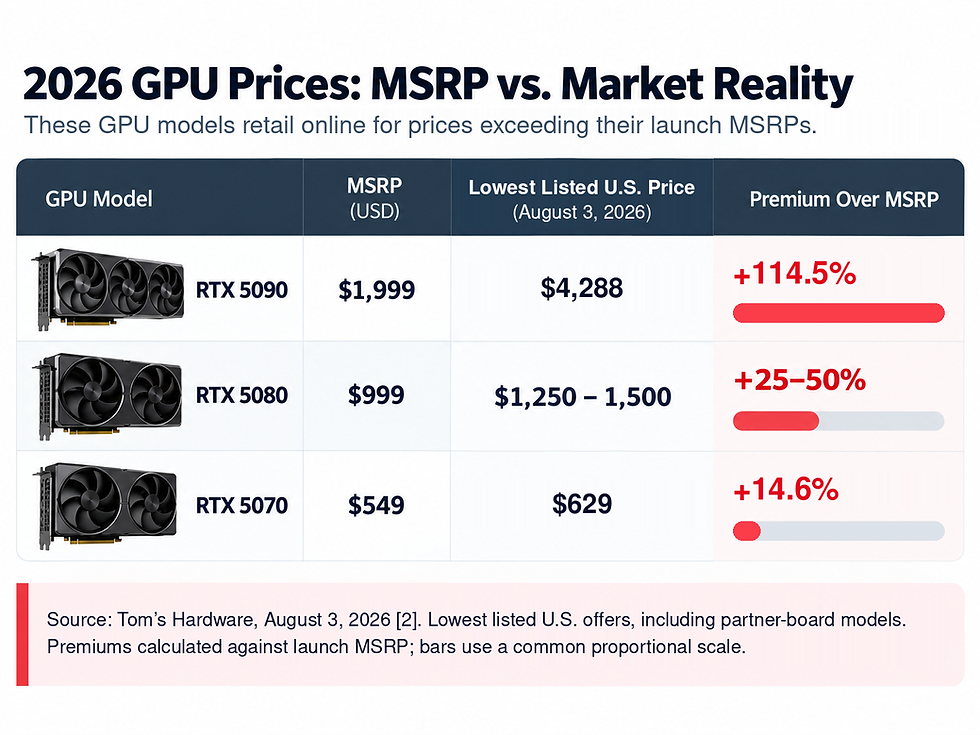
The fact that paying the launch price is now a special-event privilege is a signal that something fundamental has changed in the consumer hardware market. [2]
And QuakeCon is a particularly fitting place to see that change.
Let's take a step back in time. The year was 1996—thirty years ago. In August of that year, players who frequented the #quake channel on Internet Relay Chat—IRC, the pre-social-media backbone of early online communities—decided to meet in person. Given the network limitations of the time and their desire to meet face to face, they agreed it was time to gather. They booked a Best Western hotel in Garland, Texas, approximately two miles from id Software's offices. Roughly 30 people initially walked through the doors. They brought their computers, connected them with cables, and played together—placing the gathering among the earliest major U.S. gaming LAN parties. To the attendees' surprise, much of the id Software team showed up—including John and Adrian Carmack, John Romero, American McGee, and other members of the Quake team. They paid the network bill out of their own pockets and spent the weekend playing their game alongside fans. Carmack delivered an informal talk on the hotel porch, which later evolved into an annual keynote. There was no press release, no marketing budget and no corporate strategy—just a shared love for the game and the people who made it. By the end of the weekend, word of mouth had swelled attendance to approximately 100. That gathering became QuakeCon. [3]
Thirty years later, that impromptu LAN party has become a convention drawing more than 10,000 attendees—and in 2026 served as an inadvertent illustration of a far larger trend in gaming: How artificial intelligence demand has reversed decades of falling hardware prices in a matter of months.
Why Quake Matters
To understand QuakeCon's significance, one must first understand Quake. Not simply as a game, but as a technological milestone.
Before Quake, games such as Doom (1993) rendered convincing 3D environments within major two-dimensional constraints. Rooms could not be stacked directly above one another, and vertical aiming was not part of play. [4]
Quake, released in June 1996, changed this. It rendered fully polygonal environments where players could look in any direction, aim up and down, and navigate multi-story levels with genuine vertical complexity. [4]
Much of this was made possible by John Carmack, lead programmer and co-founder of id Software. Carmack's innovations extended beyond entertainment. His work advanced real-time 3D graphics, networking and an open-source development culture that influenced a generation of programmers. His earlier game, Doom, had already transformed gaming and popularized the first-person shooter genre on a mass scale.
Quake made two features especially important to the culture that would produce QuakeCon: online multiplayer and modding - 'user-generated content.'
Players could compete over the internet and create their own levels, characters and gameplay modes. Team Fortress, one of the most influential multiplayer games of all time, began as a Quake mod. The modding community arising from id's Doom and Quake games became a cultural engine that kept these and other games alive for decades—and helped popularize modding far beyond the FPS genre. [5]
It is noteworthy, too, that QuakeCon's Texas location was not accidental. id Software was headquartered in the Dallas area, part of a cluster of Texas-based game developers that helped establish the first-person shooter as a major genre.
The state's game-development industry now generates approximately $6.5 billion in economic impact and supports more than 22,000 jobs, with major studios and technology companies maintaining Texas operations. QuakeCon is not just a gaming event. It is a landmark of Texas technology history. [6]
From that Texas base, QuakeCon grew rapidly: [7]

From LAN Party to Institution
“LAN” stands for Local Area Network—a method of physically connecting computers in the same location so they can communicate directly. Before broadband became commonplace, LAN parties offered one of the best ways to experience multiplayer gaming without internet latency. At QuakeCon, the LAN became both infrastructure and ritual: thousands of people still haul computers to a convention center rather than simply playing from home.
The event survived the rise of broadband, consolidation among game publishers and id Software's acquisition by ZeniMax Media in 2009 because its core was never entirely commercial. Volunteers ran the event, setting up miles of ethernet cable, managing dedicated power infrastructure and coordinating logistics for thousands of attendees.
That makes QuakeCon an unusually appropriate place to observe what is now happening to the hardware economy—
AI's Memory Appetite
The current price inversion is not simply a lack of manufacturing capacity. Increasingly, it is also a matter of where that capacity is being allocated.
High-Bandwidth Memory (HBM) is specialized memory used alongside AI accelerators to move enormous amounts of data quickly—essential for training and operating large AI models.
Demand for AI-oriented memory has exploded.
TrendForce raised its 1Q26 forecast for conventional DRAM contract prices to +90–95% quarter over quarter; PC DRAM was expected to at least double. [8]
For 2Q26, TrendForce projected another 58–63% quarter-over-quarter increase in conventional DRAM contract prices as suppliers continued reallocating capacity toward HBM and server applications. [9]
By August, TrendForce estimated that HBM and RDIMM together would account for 51% of DRAM bit supply in 2026. [10]
Omdia reported that HBM supply remained fundamentally constrained and that dedicated advanced-packaging lines at TSMC were operating at full utilization. [12]
The consequence is that standard DRAM—used in PCs, graphics cards, smartphones and automobiles—faces scarcity and higher prices as a growing share of capacity and investment follows AI and server demand.
A Decades-Long Trend Reverses
The Stanford Digital Asset Management (DAM) Project, which extends John C. McCallum's historical memory-price series with current retail data, documents an extraordinary long-term decline. [11]
In 1957, transistor flip-flop memory cost roughly $411 million per megabyte—about $411 billion per gigabyte on a decimal conversion. By the 2020s, consumer DRAM had fallen to only a few dollars per gigabyte. In 2026, however, Stanford's updated retail series showed the lowest listed DDR5 prices at roughly $11.41–$13.28 per GB. In nominal dollars, the last comparable range was around 2008; adjusted to 2024 dollars, it was comparable to roughly 2011. The long downward curve had sharply reversed. [11]
That reversal is not a failure of memory technology. It reflects a market in which AI infrastructure demand is pulling scarce production toward higher-value server products and driving consumer prices upward.
The Semiconductor Bottleneck
Industry analyst Omdia projects semiconductor revenue growth of 94.1% year over year in 2026, driven overwhelmingly by AI demand. Memory ICs will account for more than 50% of total semiconductor revenue. [12]
Several bottlenecks are interacting:
HBM supply is constrained because production is significantly more complex than standard DRAM.
Advanced packaging, including TSMC's CoWoS lines, is operating near full utilization.
Leading-edge node capacity, including 3nm and emerging 2nm production, is heavily booked across major AI and compute customers.
Capacity cannot expand quickly because specialized semiconductor equipment carries long lead times.
The consequences extend well beyond graphics cards.
• Smartphones: rising component costs are feeding into device pricing.
• PCs and consumer electronics: higher memory prices and possible delays as AI and server products receive priority.
• Automotive and industrial: competition with AI demand for memory ICs and advanced packaging.
• Gaming consoles and televisions: exposure to many of the same component-cost pressures.
Omdia's Myson Robles-Bruce summarizes the outlook:
“From mid-2026 through early 2027, the semiconductor market will be defined by relentless AI demand. Capacity will remain constrained, advanced nodes heavily utilized, and memory and advanced packaging costs will continue to rise.” [12]
Production is also geographically concentrated. HBM at scale relies on just three suppliers—SK hynix, Samsung and Micron—while advanced packaging is heavily dependent on TSMC. That concentration means a natural disaster, geopolitical conflict or trade restriction could cascade through the global supply chain. [12]
For Manufacturers, a Gold Rush
For memory manufacturers, this is not necessarily a crisis. It is a gold rush.
SK hynix's Q1 2026 revenue reached 52.58 trillion KRW—approximately $40 billion—up 198% year over year, with a 77% net margin. [13]
The economic incentive is obvious. When AI infrastructure customers are willing to pay significantly more for limited manufacturing capacity, manufacturers have every reason to prioritize them.
Consumer markets are left competing for what remains.
Beyond Gaming
QuakeCon's hardware story reflects a broader economic dynamic:
When an industry faces a sudden surge in demand from a new and more profitable sector, existing consumer markets can become secondary.
The same semiconductor ecosystem supplying AI models also supplies personal computers, phones, vehicles and other electronics.
As manufacturing capacity shifts, ordinary consumers can bear the cost—not only in dollars, but in access.
Students, small-business owners, researchers, gamers and creators increasingly compete, indirectly, with some of the world's largest technology companies for a limited supply of advanced silicon.
The price of a graphics card at QuakeCon therefore becomes a small but visible indicator of something much larger:
Technological progress does not guarantee affordability.
Progress follows demand. When that demand becomes concentrated among a small number of extraordinarily well-capitalized buyers, the rest of the market pays a premium.
What This Means for Texas
There is an irony in seeing this transition at QuakeCon.
Texas has a multibillion-dollar video-game industry whose lineage runs directly through id Software and the early PC gaming culture that produced Doom, Quake and QuakeCon.
That culture was built around increasingly powerful computers becoming progressively cheaper and more accessible.
Thirty years later, the same convention now illustrates the opposite pressure.
Consumer hardware is competing for production capacity with an AI infrastructure market capable of absorbing enormous amounts of capital and silicon.
A gathering that began when roughly 30 people carried their computers into a Best Western in Garland has become a window into a global hardware economy.
And in 2026, one of the clearest signs of how much that economy has changed is remarkably simple:
At one of the world's most famous computer-gaming conventions, being allowed to buy a graphics card at its original retail price has become an event in itself. Van Shannon is our in-house Green Engineering expert. Background in critical infrastructure, general operations, and construction. When he's not holding down the machines that keep us all safe and comfy, he devotes time to next-gen ecological + ethical planning for crypto, AI & more. He loves gaming from the foundation-up!
Notes & Sources
Selected sources supporting the article’s quantitative and historical claims. References checked Sept. 16, 2026. Forecasts retain their original publication dates.
[1] NVIDIA, Andrew Burnes, “GeForce RTX @ QuakeCon 2026: GPU Giveaways, Swag, $10,000 Mod Contest & More,” Aug. 4, 2026.https://www.nvidia.com/en-us/geforce/news/quakecon-2026-win-geforce-rtx-gpus-and-more/
[2] Tom’s Hardware, Stewart Bendle, “GPU prices keep surging in 2026 — Lack of sale discounts and rising VRAM costs keep current-gen prices sky-high,” Aug. 3, 2026. The source reports lowest listed U.S. prices, not market averages.https://www.tomshardware.com/pc-components/gpus/gpu-prices-for-current-gen-nvidia-and-amd-price-increases-why-have-the-prices-not-dropped-and-can-you-still-buy-a-cheap-gpu
[3] Epic Games Store, Matt Paprocki, “QuakeCon returns to continue its history,” Aug. 10, 2023.https://store.epicgames.com/news/the-history-and-people-of-quakecon?lang=en-US
[4] WIRED, David Kushner, “Prepare to Meet Thy Doom,” May 1, 2003; see also Marc Laidlaw, “The Egos at Id,” Aug. 1, 1996.https://www.wired.com/2003/05/doom-3/https://www.wired.com/1996/08/id/
[5] Valve / Team Fortress, Robin Walker, “A History of Violence,” Aug. 4, 2011.https://www.teamfortress.com/post.php?id=5992
[6] Entertainment Software Association, “Texas (TX),” Video Game Impact Map, undated; accessed Sept. 16, 2026.https://www.theesa.com/video-game-impact-map/state/texas/
[7] QuakeCon milestone attendance and BYOC figures: historical Wikipedia event table preserved in an IPFS mirror; Guinness World Records, “Largest free Local Area Network party”; and GameSpot, “QuakeCon coordinates picked.” Attendance, computers and BYOC capacity are distinct measures; estimates are marked where applicable. These historical sources do not establish the 2026 BYOC figure, which requires a separate dated seat-map or organizer citation. The GameSpot page could not be rechecked because access was blocked.https://levantado.ddns.net/ipfs/QmXoypizjW3WknFiJnKLwHCnL72vedxjQkDDP1mXWo6uco/wiki/QuakeCon.htmlhttps://www.guinnessworldrecords.com/world-records/88099-largest-free-local-area-network-partyhttps://www.gamespot.com/articles/quakecon-coordinates-picked/1100-6091546/
[8] TrendForce, “Memory Price Outlook for 1Q26 Sharply Upgraded; QoQ Increases of All Product Categories to Hit Record Highs, Says TrendForce,” Feb. 2, 2026.https://www.trendforce.com/presscenter/news/20260202-12911.html
[9] TrendForce, “AI Server Demand to Drive Memory Contract Price Increases in 2Q26 as CSPs Secure Supply via Long-Term Agreements,” Mar. 31, 2026.https://www.trendforce.com/presscenter/news/20260331-12995.html
[10] TrendForce, “Memory Prices Soar; DRAM and NAND Flash to Account for 68% of Major CSP CapEx in 2027, Says TrendForce,” Aug. 25, 2026. The 51% figure concerns HBM and RDIMM combined as a share of 2026 DRAM bit supply.https://www.trendforce.com/presscenter/news/20260825-13198.html
[11] Stanford Digital Asset Management Project, David Shim, “Memory Prices,” continuously updated; accessed Sept. 16, 2026. Historical data draw on John C. McCallum’s dataset; recent retail observations track lowest listed prices using Keepa. See also Tom’s Hardware, Jowi Morales, “Scientist says RAM pricing has risen to normalized 2007 levels, AI shortage undid 20 years of progress in a matter of months — memory prices had been falling exponentially for decades,” updated Aug. 8, 2026. Its body reports the DDR5 comparison with approximately 2008 nominal-dollar and 2011 inflation-adjusted DRAM prices.https://dam.stanford.edu/memory-prices.htmlhttps://www.tomshardware.com/pc-components/ram/scientist-says-ram-pricing-has-reverted-to-normalized-2007-levels-memory-prices-have-been-falling-exponentially-for-decades-but-the-ai-shortage-undid-20-years-of-progress-in-a-matter-of-months
[12] Omdia, “AI demand drives 94.1% surge in semiconductor forecast for 2026,” July 30, 2026. Both the 94.1% revenue-growth figure and memory’s greater-than-50% revenue share are forecasts for 2026.https://omdia.tech.informa.com/pr/2026/july/ai-demand-drives-94-point-1-percent-surge-in-semiconductor-forecast-for-2026
[13] SK hynix Newsroom, “SK hynix Announces 1Q26 Financial Results,” press release datelined Apr. 23, 2026; webpage displays Apr. 22, 2026.https://news.skhynix.com/en/q1-2026-business-results/Copyright
AI Use: AI was used for image generation and to assist with research and editorial clarity.
GBAMFS 2026. All Rights Reserved.


Comments